
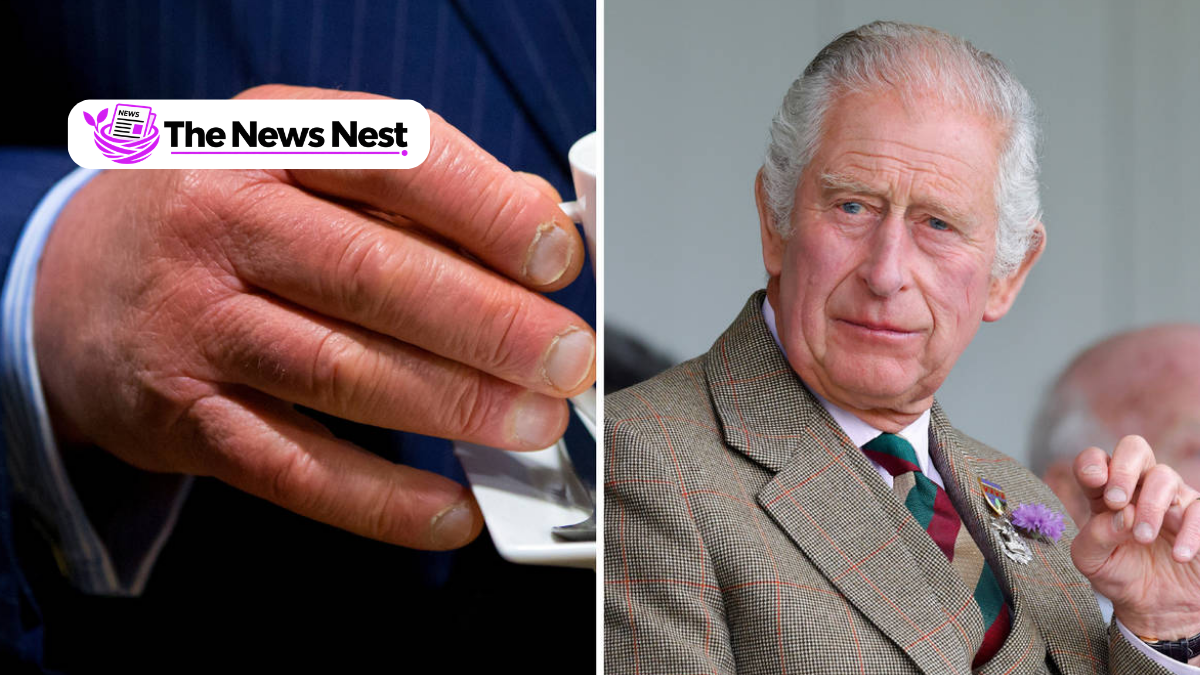
The phrase Prince Charles Fingers refers to the full, puffy appearance of King Charles III’s fingers, often nicknamed “sausage fingers”. The sources reviewed for this September 2026 article do not establish a confirmed medical cause. Charles has joked about his hands, but a joke is not a diagnosis. Photographs alone cannot establish whether fluid retention, joint inflammation or another explanation applies.
The question attracts an understandable mix of curiosity and concern. Hands feature prominently during royal greetings and ceremonies, making them easy to notice. What matters is separating the visible appearance from claims about the King’s health.
Why do people still call them Prince Charles’s fingers?
“Prince Charles” refers to the same person now known as King Charles III. The older name remains recognisable because Charles spent decades in public life before becoming monarch.
The Royal Family’s official biography records that Charles became King on 8 September 2022, following Queen Elizabeth II’s death. It also records his birth on 14 November 1948 and his creation as Prince of Wales in 1958.
Those dates explain the naming overlap. An older report about Prince Charles’s hands and a newer report about King Charles’s hands concern the same individual, although they may describe different occasions.
The distinction matters when reading health coverage. An old photograph under a current headline does not become evidence of a recent physical change. Always separate the date of the image from the date of the article discussing it.
What has King Charles said about his “sausage fingers”?
King Charles has publicly used the phrase “sausage fingers” as a joke about himself. Footage in the BBC documentary Charles III: The Coronation Year captured an exchange with Prince William during preparations for the coronation.
NDTV’s report of 24 December 2023 described William attempting to fasten a clasp on his father’s ceremonial robe. Charles responded: “No, you haven’t got sausage fingers like mine.”
The documentary aired on BBC One on 26 December 2023. The moment offers a clear example of Charles acknowledging his hands with humour rather than providing a medical explanation.
It is a memorable line, and an unusually relatable moment amid robes and royal ceremony. Even a coronation can involve a fiddly fastening.
However, the remark confirms only what Charles said. It does not confirm pain, an underlying condition, treatment or the reason his fingers look the way they do.
Has anyone confirmed why King Charles’s fingers look swollen?
The sources reviewed for this article do not confirm why King Charles’s fingers appear swollen. The Associated Press’s February 2024 account of his health history explicitly described the explanation as unresolved.
That distinction leaves room for a useful answer without inventing certainty. The public can observe the appearance of Charles’s hands and read his recorded comments. Those observations do not provide his clinical history or the findings of an examination.
An expert explaining possible causes of swollen fingers offers general medical context. Unless that expert has authorised access to relevant clinical information, the explanation does not establish what affects Charles personally.
A possible cause of swollen fingers is not a confirmed diagnosis for King Charles.
The same standard should apply to reassuring and alarming claims. Calling the appearance definitely harmless requires evidence, just as attributing it to a serious disease does. A responsible account should avoid both unsupported conclusions.
What does oedema mean, and can it affect the hands?
Oedema means swelling associated with excess fluid in body tissues. The NHS explains that fluid accumulation commonly causes swollen hands and arms, but the term alone does not identify the underlying reason.
NHS guidance lists potential triggers including prolonged inactivity, salty food, certain medicines, injury and hot weather. It also identifies medical conditions that can cause swelling.
That range explains why the word “oedema” appears in discussions of puffy hands. It supplies a general medical explanation for a type of swelling, not proof that a particular person has it.
Applied to Charles, the careful wording is that fluid retention can cause swollen hands generally. Saying that fluid retention definitely explains the King’s fingers goes beyond the evidence reviewed here.
The terminology can sound more conclusive than it is. Giving a visible feature a medical name does not automatically answer the next question: what caused it?
Is dactylitis the same thing as “sausage fingers”?
Dactylitis describes swelling along an entire finger or toe. Cleveland Clinic explains that clinicians sometimes call this “sausage fingers” because of the rounded appearance, but a casual nickname does not establish that someone has dactylitis.
The distinction concerns both meaning and context. In everyday conversation, the phrase may simply describe broad fingers. In medicine, dactylitis identifies a pattern of swelling that needs assessment.
Cleveland Clinic lists arthritis, other inflammatory conditions and infections among possible causes. Associated symptoms can include pain, warmth, colour changes and difficulty moving the affected digit.
Charles’s use of the nickname therefore cannot substitute for a clinical finding. A person can make a joke using words that also appear in medical descriptions without announcing a diagnosis.
A nickname describes an impression. A clinical assessment investigates a cause.
Keeping those meanings separate prevents an entertaining royal quotation from turning into an unsupported claim about disease.
Can arthritis make fingers look larger or swollen?
Arthritis can cause finger swelling, stiffness and changes around the joints. Different forms affect the hands differently, which is why the appearance of King Charles’s fingers cannot identify a particular type of arthritis.
The NHS describes three main hand areas that osteoarthritis often affects: the base of the thumb, the joints nearest the fingertips and the middle finger joints. Fingers may develop swelling or bumps, and some changes can remain even when pain improves.
Psoriatic arthritis presents another pattern. NHS guidance describes joint pain, swelling and stiffness, swollen fingers or toes, and possible nail changes such as small pits. Symptoms may feel worse in the morning.
These descriptions explain why arthritis enters public discussion about swollen hands. They do not establish that Charles has osteoarthritis, psoriatic arthritis or any other particular joint condition.
A useful comparison asks where swelling occurs and what symptoms accompany it. A photograph usually supplies only part of that information.
How would a doctor investigate swollen fingers?
A doctor investigates symptoms, examines the affected area and selects tests according to the suspected cause. NHS guidance on rheumatoid arthritis shows why even a familiar pattern of joint swelling requires more than visual recognition.
The NHS explains that a GP checks joint swelling and movement and asks about symptoms. Further assessment may involve blood tests, scans and referral to a rheumatologist.
One revealing figure illustrates the complexity: about 1 in 20 people without rheumatoid arthritis test positive for rheumatoid factor, according to the NHS. No blood test alone definitively proves or excludes rheumatoid arthritis.
If a laboratory result needs interpretation alongside other information, an internet photograph deserves at least the same caution.
This is why a confident caption cannot replace an examination. A viewer cannot ask a photograph whether the hand hurts, whether stiffness appears after waking or whether everyday tasks have become difficult. Those unanswered questions matter more than how persuasive a visual comparison looks.
Are King Charles’s fingers connected to his cancer diagnosis?
Buckingham Palace’s announcement of King Charles’s cancer diagnosis did not establish a connection with his fingers. The public statement should not be expanded into a medical explanation it did not provide.
On 5 February 2024, Buckingham Palace announced that diagnostic tests had identified a form of cancer after doctors noticed a separate concern during treatment for benign prostate enlargement.
The statement described the start of regular treatment and adjustments to public duties. It did not name swollen fingers as a symptom or explain the King’s hand appearance.
The documented finger joke also predates that announcement. This does not settle the medical cause, but it shows why treating every discussion of his hands as a new consequence of the announcement would be misleading.
A confirmed cancer diagnosis does not automatically explain every visible physical feature.
Any claim linking Charles’s fingers to cancer or a particular treatment requires specific evidence of that connection. General possibilities cannot supply it.
Can recent photographs show whether his hands are improving?
Recent photographs can show how King Charles’s hands looked at a particular moment. They cannot, by themselves, establish that a medical condition has improved, worsened or disappeared.
An honest comparison starts with basic questions. Do both images have reliable dates? Do they show the same hand in a comparable position? Does the accompanying report include an actual medical update?
Without that context, “better” and “worse” describe a viewer’s impression rather than a verified health finding. An image also cannot communicate symptoms that the person has not discussed.
For a September 2026 update, the useful distinction remains between new reporting and new evidence. Reposting an old image with a fresh date adds no clinical information. A genuine update would require a relevant statement or reliable reporting that establishes something previously unknown.
Curiosity is reasonable. Turning a sequence of photographs into a medical progress chart is a much larger leap.
When should swollen fingers prompt medical advice?
Unexplained, sudden, severe or painful hand swelling warrants prompt medical advice. NHS guidance recommends an urgent GP appointment or NHS 111 for unexplained swelling, redness, heat or associated fever.
Call 999 if swelling accompanies breathing difficulty or a tight, heavy or painful chest. These symptoms can indicate a serious problem.
For recurring joint pain, stiffness and swelling, the NHS psoriatic arthritis guidance advises seeing a GP even without psoriasis. The appropriate next step depends on the symptoms, not whether the hands resemble a public figure’s.
Celebrity photographs are an unreliable reference point for personal health. A familiar appearance cannot tell someone what is happening in their own body, and Charles’s private medical circumstances cannot guide another person’s treatment.
Frequently asked questions
King Charles’s finger appearance raises questions about both royal reporting and medical terminology. These brief answers distinguish documented information from assumptions.
Why are Prince Charles’s fingers so swollen?
The sources reviewed do not establish a confirmed cause of King Charles’s finger appearance. Several conditions can cause swelling, but photographs cannot determine which explanation applies to him.
Did King Charles call his hands “sausage fingers”?
Yes. The BBC documentary Charles III: The Coronation Year captured King Charles joking about his “sausage fingers” with Prince William during coronation preparations.
Does King Charles have arthritis in his fingers?
The sources reviewed do not establish an arthritis diagnosis explaining King Charles’s fingers. General information about arthritis should not be mistaken for confirmation of his personal medical condition.
Is oedema the same as dactylitis?
No. Oedema describes swelling from fluid accumulation, while dactylitis describes swelling of an entire finger or toe. Neither term alone identifies the underlying cause.
Are swollen fingers always a sign of serious illness?
No. Swelling has several possible explanations, but unexplained or concerning symptoms need assessment. Sudden pain, redness, heat or breathing problems should prompt appropriate urgent help.
